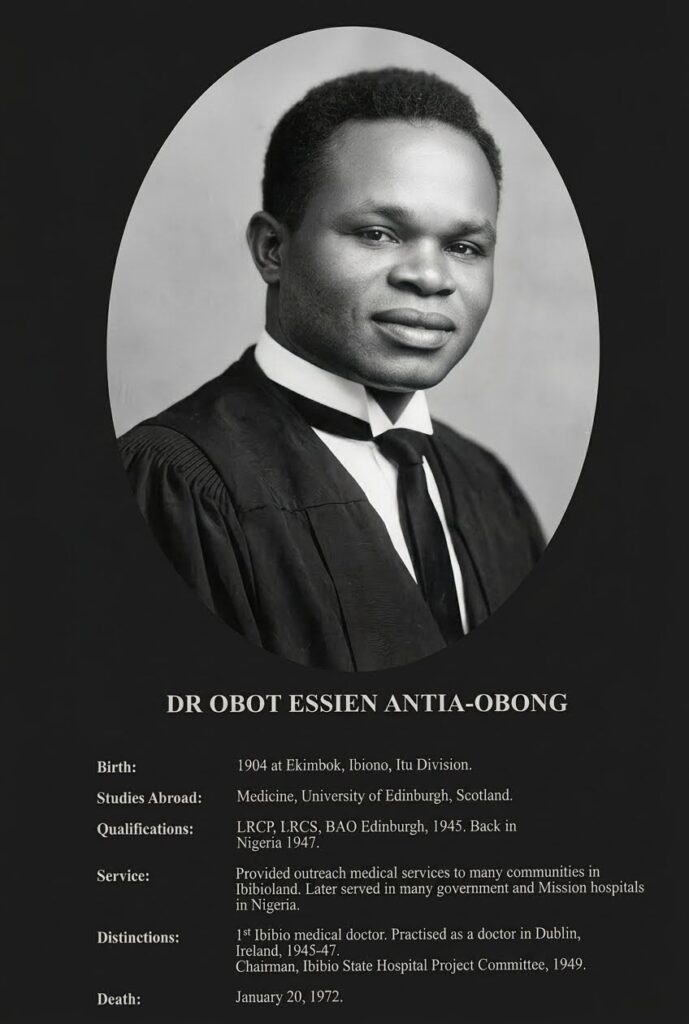
There are lives that are remarkable because of what they achieved, and there are lives that become part of the history of a people because their achievements opened doors through which generations would later walk.
The story of Dr. Obot Essien Antia-Obong belongs to the latter category.
Physician, pioneer scholar, community servant and one of the celebrated beneficiaries of the historic Ibibio Union overseas scholarship programme, Dr. Antia-Obong occupies a distinguished place in the history of Akwa Ibom. He was among the first sons of the then “Ibibio country” to travel overseas, acquire a professional medical education and return home to serve his people.
He was born in Ekimbuk in present day Ibiono Ibom Local Government Area, into the family of Chief Essien Akpan Antia, a prominent chief of the Ibiono Ibiaku clan, Warrant Chief of the British Native Court, presiding officer of the Native Court, and Obong of Ekimbuk, traditionally known as Ikpaisong Ibiono and Obong Ekimbuk Etok.
His father died in 1941, while his mother died when he was very young. His much older half brother, already a teacher in Calabar, recognised his exceptional intelligence and took him to the city for better educational opportunities. That decision changed the course of his life.
In Calabar, Obot attended Duke Town Primary School and later Duke Town Secondary School, where he consistently distinguished himself as one of the brightest students.
After completing his secondary education, he secured employment in the office of the District Officer at Opobo, becoming a senior member of staff and serving frequently as a translator in the Native Court. His intelligence, composure and command of language earned him the respect of many of the chiefs who appeared before the court.
It was during this period that he changed his name from Obot Essien Akpan to Obot Essien Antia-Obong because another court clerk had a similar name. The new name eventually became official when he travelled to Britain.
The story of Dr. Antia-Obong cannot be separated from the remarkable vision of the Ibibio Union.
Founded in 1928, the Union promoted unity, self help, education and communal advancement. Its leaders understood that if the people were to determine their own future, they had to educate their children and prepare them for leadership.
In 1938, the Union launched its pioneering overseas scholarship programme, selecting six young men from the major districts of the then “Ibibio country.” They included Bassey Udo Adiaha Attah, Ibanga Udo Akpabio, James Lawson Nsima, Egbert Udo Udoma, Asuquo Udo Idiong and Obot Essien Antia-Obong.
They would later be remembered as the “Merchants of Light.”Both Opobo (as Ikot Abasi was then known as) and Itu Districts wanted Antia-Obong. Opobo already had Egbert Udo Udoma, whom it retained, while Antia-Obong was released to Itu and selected to study Medicine in Britain.Medicine had not originally been his childhood ambition, but the Union understood the urgent need for indigenous doctors at a time when malaria and other diseases posed major threats to the population.
The financial burden was enormous. In Itu and Ibiono, a large tract of wild oil palm trees was designated to raise funds for his education. The proceeds from the palm produce helped finance his studies abroad.It was a powerful demonstration of communal sacrifice: an entire people investing in the education of one gifted son because they understood that his success would eventually benefit many.
While Antia-Obong was studying in Britain, tragedy struck the scholarship programme.Asuquo Udo Idiong of Abak District, another of the original scholars, had been sent to Canada to study Medicine. He died there during his medical studies.The Union subsequently selected Effiong Udo Ekpo of Abak as his replacement and sponsored him to study Medicine in England, ensuring that Abak District’s educational opportunity did not disappear with Idiong.The tragedy also influenced the Union’s dream of establishing the Ibibio State Hospital at Ikot Okoro ( now the General Hospital, Ikot Okoro in Oruk Anam Local Government Area).The proposed hospital was intended partly as a memorial to Idiong and as an institution through which modern medical care could be brought closer to the people.
When Antia-Obong qualified in Edinburgh in 1945 as the first Ibibio medical doctor, his return appeared to bring that medical vision closer to reality, as he was designated to become in charge of the hospital. In 1949, he became Chairman, Ibibio State Hospital Project Committee.
Antia-Obong obtained the L.R.C.P. Edinburgh, L.R.F.P.S. Glasgow and L.R.C.S. Edinburgh qualifications in 1945.On 5 July 1950, he was appointed into the Medical Services of the Eastern Region and posted as Medical Director of St. Margaret’s Hospital, Calabar.His career subsequently took him through several medical stations, including Iquita General Hospital, Oron, and later Eket during the turbulent years of the Nigerian Civil War. His final station was General Hospital, Opobo (as Ikot Abasi was then called.)
But his service went beyond hospital walls.He believed Western medicine should reach ordinary people in their villages. He therefore embarked on medical missions across Ibibio land, travelling from community to community and taking healthcare closer to the grassroots.In doing so, he was repaying the community that had invested in his education.
During the Civil War, he was picked up by Federal forces and falsely accused of being a collaborator. He narrowly escaped execution in Uyo.
Behind the doctor was a family man.
Dr. Antia-Obong was married to Mrs. Iquo Anita Obong, a teacher. Together they raised children whose lives reflected the opportunities that education had opened.They included Dr. Essien Antia-Obong, a biochemist and businessman in the United States; Mrs. Umo Ikiddeh, wife of the famed Professor Ime Ikiddeh and mother of lawyer/writer, Ata Ikiddeh; Mrs. Ako Anthony Bassey, a nurse; Professor Obot Essien Antia-Obong, a paediatrician; Mr. Mfoniso Antia-Obong, one of the pioneering senior staff of the Independent National Electoral Commission; and Dr. Akebong Iniakponiko.
The educational investment that began with a boy from Ekimbuk therefore continued through his children and subsequent generations.
On 20 January 1972, Dr. Obot Essien Antia-Obong died suddenly following heart complications.
He was only one man, but his life formed part of a much larger story: the story of a people who recognized education as an instrument of collective transformation.
As Akwa Ibom celebrates its 39th anniversary, Dr. Obot Essien Antia-Obong deserves to be remembered, alongside those of the pioneers who helped lay the foundations of the society we know today.He remains one of the HEROES of that generation.
#AkwaIbom@39
#IbomLeadingLights
#CelebratingOurHeroes
#39Heroes39Prides
#HeroObotEssienAntiaObong
#The39thAnniversaryCollectives
#AkwaIbomStateMinistryOfInformation
#AriseAgenda