When Senator Emmanuel Ibok Essien took a position paper on the controversial onshore-offshore dichotomy to a National Assembly Caucus meeting in the early years of Nigeria’s Fourth Republic, he said he knew the issue was explosive. What he did not anticipate, at least by his account, was the intensity of the confrontation that followed.
The paper, which argued for the rights of oil-producing communities and the Niger Delta in the distribution of the country’s petroleum wealth, was reportedly taken by the State Security Service (SSS) to Abuja. Essien said he was subsequently summoned to a meeting of the National Security Council, where he faced the country’s security chiefs.
Those present included the Minister of Defence, the Director-General of the SSS, the National Security Adviser, the Director-General of the National Intelligence Agency and other security officials. The Inspector-General of Police was out of the country, so a Deputy Inspector-General represented him.
“They accused us of treason and felony because of our position on the issue,” the former lawmaker recalled.
But he said he refused to retreat.
“I stood my ground because I believed we were fighting for the rights of our people.”
For Essien, the episode was more than a dramatic chapter in his political career. It was part of a broader struggle over who should benefit from the wealth extracted from the Niger Delta, a question that shaped his years in the National Assembly and later informed his involvement in the Pan Niger Delta Forum (PANDEF), which he chaired.
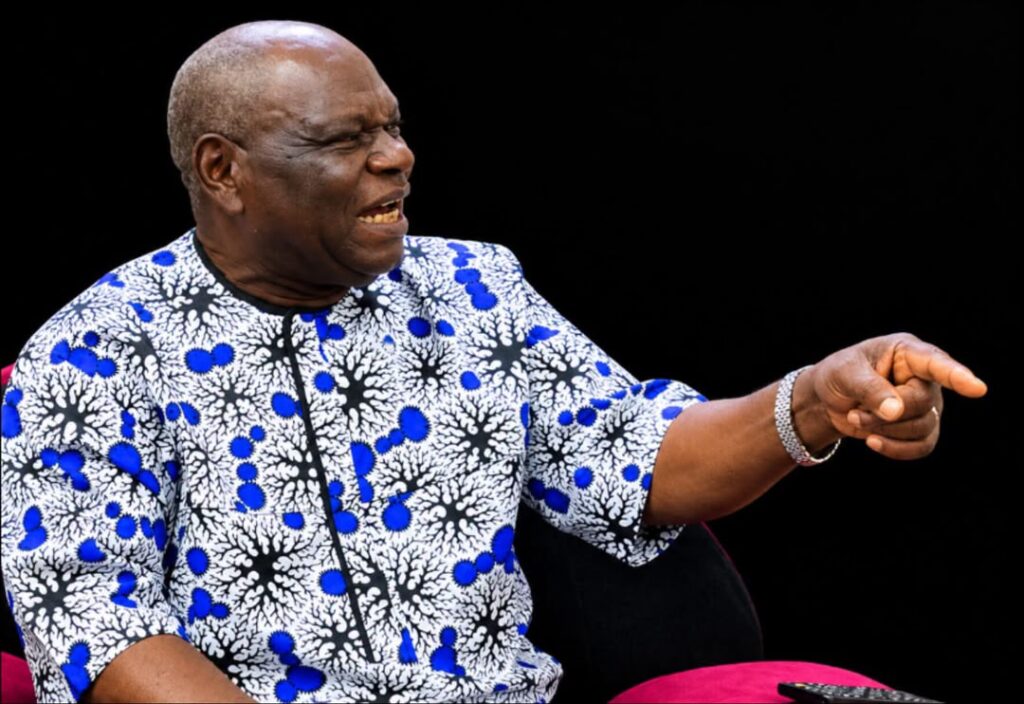
In an interview with ARISE STANDARD, the former senator revisited that period, his political battles in Akwa Ibom, his assessment of Governor Umo Eno’s administration and the emergence of “Akwa Ibom United” as a political philosophy built around cooperation among influential state leaders.
His account offers a glimpse into a political career defined, in his telling, by resource justice, loyalty, negotiation and an insistence that the state’s interests should take precedence over individual ambitions.
▪️ The Confrontation that shaped the narrative
Senator Emmanuel Ibok Essien confronted former President Olusegun Obasanjo over the distribution of Nigeria’s oil wealth, he said he was prepared to face the consequences, even if it meant being branded an enemy of the state.
The former lawmaker recalled presenting a position paper on the controversial onshore-offshore dichotomy at a meeting of the National Assembly Caucus in 2002, an intervention he said triggered a confrontation with Former President Obasanjo and the country’s security chiefs.
According to Ibok Essien, the State Security Service (SSS) immediately took his paper to Abuja, prompting the president to summon him and two other political figures to a meeting of the National Security Council.
He said the president confronted them over their position on the matter, accusing them of treason and felony.
“I was the one who presented what I called my own position, because I didn’t want to implicate any other person. When I presented my own position, it was explosive,” Sen. Ibok Essien said in an interview with ARISE STANDARD.
He said former senator Udoma Udo Udoma had adopted his paper as the position of the National Assembly caucus of Akwa Ibom lawmakers, leading to the meeting at which security chiefs were present.
Recounting his exchange with former President Obasanjo, Sen. Essien said he challenged the president to consider the consequences of refusing the Niger Delta’s demands.
“It was during the Ascension period in the Christian calendar. By the time I finished speaking to him for about 10 minutes, he could hardly respond,” he said.
He added that he warned the president that failure to address the injustice could have grave consequences for Nigeria, stressing that he spoke not merely as a senator but as a prophet of God.
“I quoted the Bible passage about Prophet Elijah’s confrontation with King Ahab over Naboth’s vineyard, condemning the seizure of Naboth’s inheritance and the injustice surrounding his death. Elijah pronounced God’s judgment on Ahab, prophesying that dogs would lick his blood and that calamity would befall his royal house,” he said.
Essien further claimed that Obasanjo eventually conceded to the demand he was pressing. He said the former president continued to regard him as an “evil man” because of the confrontation.
The former senator’s account, which he said would be documented in a forthcoming book, presents the resource-control agitation as one of the defining struggles of his political career.
For him, the dispute was about more than revenue allocation. It was about whether communities producing the country’s petroleum wealth would receive a fair share of the resources extracted from their land and waters.
Here him:
Up till today, Obasanjo calls me an evil man. But he had to give us what we demanded because I believe that was the only way out for him.
I told him that if he did not address the issue, he would turn me into a gorilla, and I was ready to fight. I was not joking. I was prepared to fight to ensure that our people received what was due to them.
A man dies only once, so I do not tolerate nonsense when it comes to defending the interests of our people.
▪️ Resource control: ‘We were ready to fight for our own’
Ibok Essien said his involvement in the Pan Niger Delta Forum (PANDEF), which he later chaired, was a continuation of the same struggle.
He argued that oil-producing communities could not continue to bear the consequences of extraction while other parts of the country benefited disproportionately from the resources.
“In PANDEF, it was still the struggle, the same struggle, on how to see how we can benefit from our resources, because you can’t just be producing and then other people are benefiting,” he said.
He also recalled the region’s engagement with the Petroleum Industry Bill (PIB), saying Niger Delta advocates had pushed for provisions that would deliver greater benefits to the oil-producing communities.
Although he acknowledged that the outcome did not meet all their expectations, he argued that the present region’s representatives in the National Assembly had not pressed their demands forcefully enough.
Ibok Essien contrasted that experience with his account of the Senate battle over the NDDC Bill, which he said demonstrated the leverage and courage lawmakers could exercise when they acted collectively.
According to him, after the president withheld assent to the bill and it was returned to the National Assembly, South-South senators organised a walkout to pressure their colleagues to override the presidential veto.
He said he called on fellow lawmakers from the South-South to leave the chamber when he believed the process was not progressing as it should.
“I called out my colleagues from South-South and said, ‘Let’s walk out, and let them go ahead and let me see whether they will go and produce the oil,’” he recalled.
Sen. Essien said the strategy forced negotiations, adding that lawmakers subsequently returned to the process and 93 senators voted to override the president’s veto.
The account, he said, illustrated the importance of political courage and collective action in securing concessions for the Niger Delta.
“There are things you do, and people respect you,” he said.
▪️ Eno has ‘over-delivered’ on promises
Turning to contemporary politics in Akwa Ibom, Essien said Governor Umo Eno had performed beyond his campaign promises as the first phase of the administration’s ARISE Agenda approached its conclusion.
“I like to speak straight,” he said. “My assessment is that this present governor, God is with him. I would say he has over-delivered on his promises.”
Ibok Essien said several of the governor’s campaign commitments had either been completed or were being implemented, citing the ongoing construction of the Ikot Ekpene International Market, road projects in the area and the continuation of projects inherited from previous administrations.
He expressed hope that the first phase of the international market would be completed before the end of Mr Eno’s first term, subject to weather and other factors.
He added that some roads being constructed in Ikot Ekpene had not been specifically promised during the campaign.
“He has the Finisher’s Anointing,” Ibok Essien said.
“If he did not do well, I would say he did not do well. But he has done well.”
The former lawmaker described the governor as a man of his word, saying his confidence in Mr Eno was based on what he considered the administration’s record of implementing its commitments.
▪️ Why Eno’s akara story resonates
Sen. Ibok Essien also defended the governor’s advocacy for entrepreneurship, including his account of making money from selling akara, saying the message was intended to encourage residents to look beyond government employment.
“He was trying to tell Akwa Ibom people that they should embrace entrepreneurship and not always depend on government jobs,” he said.
According to Mr Essien, the state’s traditional reliance on civil service employment has limited appreciation of the income-generating potential of small businesses.
He cited his experience as a partner in a Mr Bigg’s outlet in Ikot Ekpene between approximately 2005 and 2010, claiming that the business generated daily sales of between ₦700,000 and ₦800,000 from snacks, with figures rising to between ₦2.5 million and ₦3 million on some festive days.
He also said his oil-palm plantation generated between ₦1.5 million and ₦2 million monthly from the sale of palm bunches, without processing them into palm oil.
“The problem is that people don’t invest enough. People don’t try investment,” he said.
His argument was that business opportunities should not be dismissed because they appear modest or fall outside conventional career paths. Rather, he said, residents should develop the skills and willingness to identify viable investments.
▪️ Akwa Ibom United’ and the politics of cooperation
Essien’s political philosophy was also shaped by the fierce alignments that characterised Akwa Ibom politics in the early years of the Fourth Republic.
He recalled his role in the Abuja Front, a political grouping that supported the administration of former Governor Victor Attah at a time when the governor faced strong opposition from some political actors.
Essien also traced the evolution of Akwa Ibom politics from the Abuja Front of the early Fourth Republic to the present “Akwa Ibom United” philosophy, which he attributed largely to cooperation between Governor Eno and Senate President Godswill Akpabio.
He recalled being a central figure in the Abuja Front, saying he believed that people who helped form a government had a responsibility to remain engaged with it.
“We made Obong Victor Attah Governor, so I could not run away from the government,” he said.
He said only four members of the National Assembly stood with the governor at the time, but he remained confident that the group would prevail.
Essien said the current political climate was different because of the relationship between Mr Eno and Mr Akpabio.
He disclosed that although he had not initially supported Sen. Godswill Akpabio politically, he backed his bid for the Senate presidency after he won the election. He said he personally lobbied fellow senators in the chamber to support the former governor.
He also recalled that he and other political leaders, including Governor Eno went to congratulate Senator Akpabio after his Senate President election victory, even though they belonged to different political parties at the time.
For Ibok Essien, the relationship reflected a calculation that Akwa Ibom could gain more by working with influential political leadership than by allowing partisan disagreements to dominate public affairs.
“The interest of Akwa Ibom was paramount, not our individual interests,” he said.
“That is why we have Akwa Ibom United.”
The phrase, he suggested, captures a political arrangement in which cooperation is considered a means of securing development for the state. Whether that unity can accommodate competing interests and withstand the pressures of electoral politics remains a question for the months ahead.
▪️ Ikot Ekpene district’s 2027 position
On the 2027 elections, Essien said Ikot Ekpene Senatorial District had a long tradition of bloc voting, dating back to the days of the National Council of Nigeria and the Cameroons (NCNC).
He cited previous voting patterns involving political figures such as Akpan Isemin, Victor Attah, Godswill Akpabio and Udom Emmanuel, arguing that the district had historically made collective decisions about which candidates to support.
He said the district withheld its votes from Sen. Godswill Akpabio in 2019 when its political leaders decided against supporting him, but rallied behind him when they later agreed to back his return to the Senate.
According to Essien, leaders from the district had invited Governor Umo Eno and indicated their readiness to support him because of his administration’s performance.
“So, when we looked at what Governor Umo Eno is doing, we invited him and told him that we were ready to give him a good vote because of his performance,” he said.
“So, for sure, he will get bloc votes.”
He added that political leaders in the district encouraged voter registration and turnout, expressing confidence in their support for the governor.
“Governor Umo Eno has nothing to fear because we in Ikot Ekpene Senatorial District are solidly behind him,” he said.