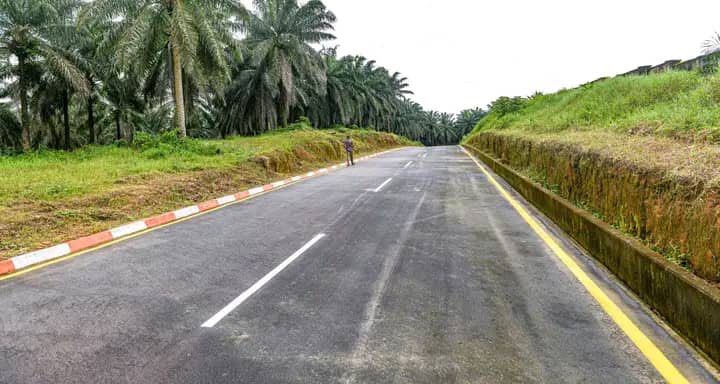
For farmers around the Dakkada Global Oil Palm Estate in Esit Eket Local Government Area of Akwa Ibom State, getting farm produce to market may soon become less of a struggle, following the commissioning of a 1.35-kilometre access road by the state government.
The road, comprising the estate’s main access and internal routes, was commissioned on Friday as part of activities marking the 39th anniversary of Akwa Ibom State, with its significance extending beyond transportation to agriculture, employment and the livelihoods of communities around the plantation.
Representing Governor Umo Eno at the ceremony, Amb. Assam Assam, SAN, said the project was conceived as an economic intervention after the governor visited the estate shortly after his nomination and saw firsthand the difficulties created by poor access. He said the governor had observed that the condition of the road was contributing to losses, including theft, and subsequently promised to provide the needed infrastructure.
With the new road, farmers and workers can move more easily into the plantation, while the evacuation of oil palm produce is expected to become faster and more efficient. For investors and businesses, improved access could also make the estate more attractive as a base for agricultural production and related enterprises.
Assam described the project as a purpose-built farm road rather than merely another urban infrastructure project, stressing that its ultimate value would be measured by the productive activities it enables. He also disclosed that the state was working on plans for additional road infrastructure in the area, including a proposed road to the waterfront.
The Chairman of Esit Eket Local Government Area, Hon. Uduak Ikot, said the intervention had the potential to touch the lives of farmers, residents and businesses, describing it as a major boost to economic activities in the area. She commended the governor for placing agriculture and infrastructure among the priorities of his administration.
The physical quality of the road was also designed to withstand the environmental challenges of the area. According to the Works Ministry, the 7.3-metre carriageway has side drains and three culverts, with a compacted sub-grade and sub-base, a 150mm stone base and a 50mm asphalt surface.
Commissioner for Power, Rt. Hon. Iniobong Robson, said the improved access had changed the prospects of the estate by making it easier for farmers, workers and potential investors to reach the plantation and move agricultural products. He also pointed to other government interventions in Esit Eket, including a health centre, as evidence of wider development efforts.
For the traditional institution, the road represents more than asphalt and drainage. HRM Nso-Aduok Etteudo said the infrastructure could help revive oil palm production, create jobs and stimulate new businesses, offering young people and residents opportunities that depend on a functioning agricultural economy.
The commissioning was one of the projects unveiled under the administration’s “39 Projects in 30 Days” programme marking Akwa Ibom’s 39th anniversary. But for the farmers and communities around Dakkada Oil Palm Estate, its real significance may ultimately be found not in the ceremony, but in the produce that reaches the market, the jobs created and the businesses that begin to grow along a road that has finally made the plantation easier to reach.