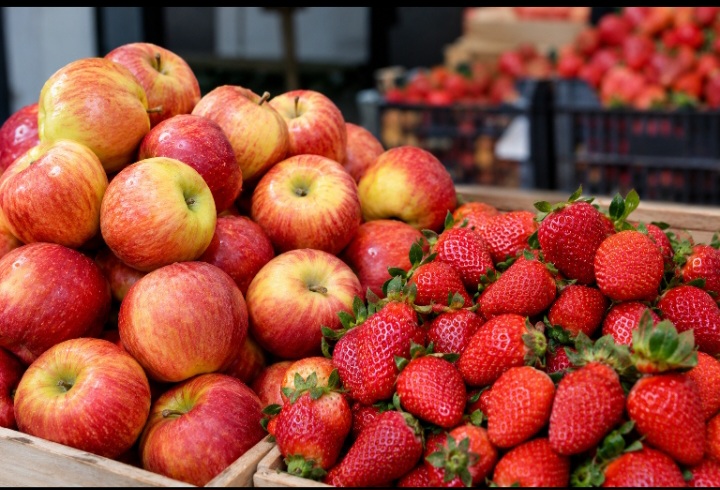
Nigeria imported apples and strawberries worth approximately N33.03 billion in the first half of 2026, as local farmers continue to face inadequate agricultural support and difficulties transporting perishable produce to markets.
Data from the National Bureau of Statistics (NBS), cited by Daily Trust, showed that apple imports accounted for N10.38 billion in the first quarter, while imports of apples and strawberries reached N22.65 billion in the second quarter. South Africa was identified as a source of the imported fruits.
Despite favourable growing conditions in parts of the country, domestic apple production remains limited. Mohammed Gettado, a former President of the All Farmers Association of Nigeria (AFAN), told Daily Trust that farmers in Plateau State cultivate apples on a small scale but lack the support needed to expand production.
Gettado identified inadequate government intervention, limited access to improved varieties and farm inputs, and the perception of apples as a fruit for wealthy consumers as factors holding back production. He said timely access to fertilisers, agrochemicals, improved seedlings and reliable markets could help farmers increase output and make apples more affordable.
Strawberry production faces additional challenges, particularly the cost and difficulty of transporting fresh produce from farms to consumers. Daily Trust reported that Deola Balogun, Chief Operating Officer of Limlim Foods, attributed some of the difficulties facing strawberry businesses around Jos, Plateau State, to inadequate transport options.
Balogun said the suspension of Arik Air’s operations to the area had made it more difficult to move strawberries to major markets. She explained that fresh berries have a short shelf life at room temperature, leaving producers with limited time to deliver them before they spoil.
According to Balogun, an attempt to transport strawberries by road resulted in losses of between 20 and 30 per cent despite the use of Styrofoam boxes and ice. She attributed the losses to heat exposure, damaged packaging, checkpoint delays and poor road conditions.
She warned that transportation challenges could undermine the value of large harvests, citing a scenario in which Plateau State produces 700 tonnes of strawberries in a season but loses half to logistics problems. Such losses, she said, could leave markets dependent on imported fresh strawberries and processed products.
Balogun said improved transportation and distribution systems would help reduce post-harvest losses and enable locally produced strawberries to reach consumers before spoiling.