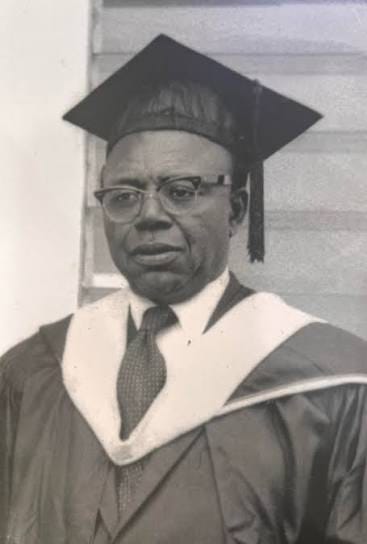
Obong Bassey Udo Adiaha Attah was a distinguished scholar, agricultural scientist and public servant, whose life of excellence laid a strong foundation for service and leadership.
He belonged to that pioneering generation of Akwa Ibom sons whose intellectual accomplishments transcended the boundaries of their immediate communities and became part of the early story of Nigeria’s advancement in education, agriculture and public service.
Born on August 8, 1908, in what is the present Ibesikpo Asutan Local Government Area and called to glory on July 31, 1990, Obong Attah lived a life of learning, service and impact.
He started his primary education at Nsit People’s School, Afaha Offiong, before he transferred to Duke Town Primary School, Calabar, where he passed his Standard Six in 1926. His solid performance led to his name being inscribed on the Honours Roll of the school. For his secondary education, he attended the Duke Town Middle School, Calabar.
He went on to study at the School of Agriculture, Moor Plantation, Ibadan on scholarship from the colonial government.
Obong Attah was one of the “Merchants of Light”, a beneficiary of the Ibibio Union’s scholarship scheme. Through the scholarship, he pursued higher education in Agriculture in the United States. The scholarship was part of the historic educational initiative of the Ibibio Union, which in the late 1930s sent a select group of young Ibibio men abroad to acquire knowledge and skills that would be deployed for the advancement of their people. The six beneficiaries became symbols of what collective investment in education could achieve.
He obtained a Bachelor of Science (B.Sc.) degree in Agriculture from Tuskegee Institute, Alabama, in 1941. In 1942, he made history as the first Nigerian to earn a Master’s degree in Agriculture from Iowa State College. His achievement was remarkable not only because of the academic distinction it represented, but also because it placed a Nigerian among the pioneers of advanced agricultural scholarship at a time when university education itself was still a rarity for Nigerians.
He subsequently advanced his professional training by obtaining a Postgraduate Diploma in Tropical Agriculture from Imperial College, Trinidad, in 1945. His academic journey demonstrated a remarkable commitment to specialised knowledge and reflected the philosophy of the “Merchants of Light,” that education acquired abroad must ultimately become an instrument for the transformation of society.
From 1943, he served as a Research Professor at Southern University, Louisiana, contributing to agricultural research and scholarship at an international level. His work in the United States placed him within the emerging generation of African scholars who were acquiring modern scientific knowledge and participating in the intellectual and professional institutions of the wider world.
His accomplishments were particularly significant because agriculture occupied a central place in the economic life of colonial Nigeria. At a time when scientific agriculture was still developing, his training and experience positioned him among the pioneers who understood the importance of applying modern agricultural knowledge to Nigeria’s development.
Widely regarded as the Father of Scientific Agriculture in Nigeria, As a pioneer in the field, he introduced a lot of innovations and contributed to the oil palm rehabilitation scheme that enhanced the West African Institute for Oil Palm Research (WAIFOR), and the Nigeria Institute for Oil Palm Research (NIFOR), where he worked after voluntarily leaving the colonial Agriculture Department where he served as a Senior Agricultural Officer.
He also introduced many economic crops , grains and seedlings to Nigeria in addition to experimention on the cultivation of onions in Southern Nigeria. He also introduced a special breed of pigs, popularly known as White land rave, and special breeds of birds known as Rhode Island. He introduced cassava species too.
Working with the Eastern Nigeria government under Premier Michael Okpara, he was one of those behind the region’s plantation agriculture schemes.
He equally served at the University of Nigeria, Nsukka, as pioneer Farm Manager.
He later established his own farm plantations, including at Mfamosong in Cross River State, promoting agricultural enterprise and self-reliance. In doing so, he demonstrated that his understanding of agriculture was not confined to the classroom or laboratory, but could be translated into practical enterprise and productive engagement with the land.
He was the proud father of Obong Victor Attah, who served as Governor of Akwa Ibom State for two terms, from 1999 to 2007. The younger Attah’s later emergence as one of the most prominent political leaders in Akwa Ibom added another dimension to the family’s enduring tradition of education, professional excellence and public service.
In recognition of his contributions to education, agriculture, public service and nation-building, he was awarded the National honour of Member of the Order of the Niger, MON.
As Akwa Ibom celebrates 39 years of statehood, we honour the memory and legacy of Obong Bassey Udo Adiaha Attah, as a hero and pathfinder whose vision continues to inspire generations.
#AkwaIbom@39
#IbomLeadingLights
#CelebratingOurHeroesOurPrides
#HeroBasseyAttah
#The39thAnniversaryCollectives
#AkwaIbomStateMinistryOfInformation
#AriseAgenda