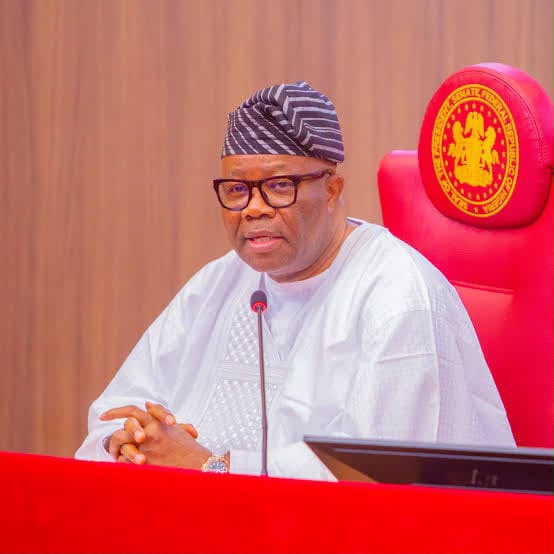
Senator Godswill Obot Akpabio, GCON, belongs to the generation of Akwa Ibom sons whose political journeys have carried them from the grassroots of state politics to the very centre of Nigeria’s national leadership.
Lawyer, politician, former Governor, former Minister and now President of the Senate of the Federal Republic of Nigeria, Senator Akpabio has traversed several of the most consequential levels of Nigeria’s political and public life.
As of today, he occupies the highest ranking elected political office held by an indigene of Akwa Ibom State: President of the Senate and Chairman of the National Assembly, presiding over one of the two chambers of Nigeria’s federal legislature.
His journey from Ukana Ikot Ntuen in Essien Udim Local Government Area to the leadership of Nigeria’s Senate is one of the most remarkable political trajectories of Akwa Ibom in the Fourth Republic.
Akpabio was born on December 9, 1962, and was raised in a family whose circumstances required determination, discipline and resilience. He lost his father at a young age, and his mother, Madam Lucy Obot Akpabio, played an important role in raising him and his siblings.
His early education began at Methodist Primary School, Ukana, after which he attended Federal Government College, Port Harcourt where he was the General Prefect.
He proceeded to the University of Calabar, where he studied Law.
Even as a university student, Akpabio displayed an early interest in leadership and public affairs. He became Speaker of the Students’ Union Parliament, giving him an early experience in debate, representation and the management of competing interests.
After completing his legal studies, he proceeded to the Nigerian Law School and was called to the Nigerian Bar.
His legal training would later become an important foundation for a career that would take him through business, government and politics.
Akpabio began his professional career as a lawyer.His early years in legal practice exposed him to corporate and commercial transactions and to the rapidly developing business environment of Nigeria. H moved into the corporate sector and became involved in the emerging telecommunications industry.
He eventually rose to become Managing Director and Chief Executive Officer of EMIS Telecoms Limited, giving him experience in corporate administration and private-sector management.
In 2002, Akpabio was appointed Commissioner for Petroleum and Natural Resources in Akwa Ibom State.
He subsequently served as Commissioner for Local Government and Chieftaincy Affairs and later as Commissioner for Lands and Housing.These assignments exposed him to some of the most sensitive areas of state administration, including natural resources, local government, traditional institutions, land administration and urban development.
It was also during this period that his political profile began to expand significantly.
In 2006, Akpabio contested for the governorship of Akwa Ibom State on the platform of the Peoples Democratic Party (PDP).He emerged as the party’s candidate and went on to win the 2007 governorship election.
On May 29, 2007, Akpabio became Governor of Akwa Ibom State.
He was re-elected in 2011 and completed two terms in office on May 29, 2015.
His eight years in the Government House, Uyo, became the defining period of his emergence as a major figure in Nigerian politics.
His administration placed considerable emphasis on physical infrastructure and public development.Road construction, urban renewal, education, healthcare, sports infrastructure and public facilities featured prominently in the administration’s development programme.
Among the most visible projects associated with his tenure was the Godswill Akpabio International Stadium.The facility is one of the most recognisable landmarks of the state and host to major national and international sporting events.
His administration also pursued extensive road construction and urban development, particularly in Uyo, Ikot Ekpene and other parts of the state.
The administration’s political message was encapsulated in the phrase “Uncommon Transformation.”
After completing his second term as Governor in 2015, Akpabio moved from state executive office to the National Assembly.
He contested and won election to represent Akwa Ibom North West (Ikot Ekpene) Senatorial District in the Senate.
In July 2015, he emerged as Minority Leader of the Senate, becoming one of the principal figures in the opposition leadership of the upper chamber.His tenure as Minority Leader further expanded his national political profile.
He became a prominent participant in debates concerning national governance, the economy, federalism and the political direction of Nigeria.
In 2018, Akpabio made one of the most consequential political decisions of his career.He left the PDP and joined the All Progressives Congress (APC).The move transformed his political alignment at the federal level.
It also brought him into closer proximity with the Buhari administration and eventually opened the way to another national executive assignment.
In 2019, President Muhammadu Buhari appointed Akpabio Minister of Niger Delta Affairs.It was an assignment of particular significance given Akpabio’s origins in the oil-producing Niger Delta and his previous experience as Governor of Akwa Ibom State.As Minister, he became responsible for a federal ministry whose mandate covered some of the most politically and economically sensitive issues in the Niger Delta.His portfolio included issues relating to regional development, infrastructure, the Niger Delta Development Commission and other federal interventions in the region.
He also became involved in efforts concerning the completion of the East West Road, the Ogoni clean up and broader development challenges facing the Niger Delta.
Following his departure from the Federal Executive Council in 2022, Akpabio returned to elective politics.
In the build-up to the 2023 general elections, he contested for the Senate seat representing Akwa Ibom North West.He won the election and returned to the National Assembly.
By this time, he was returning as one of the leading contenders for the leadership of the 10th Senate.The governing APC eventually endorsed him for the position of Senate President.
On June 13, 2023, the 10th National Assembly was inaugurated.
The election for Senate President followed.Akpabio contested against Senator Abdul’aziz Yari and was elected President of the Senate, securing 63 votes against Yari’s 46.
With his election, an Akwa Ibom politician who had served as a commissioner, Governor, senator, Senate Minority Leader and Federal Minister assumed the leadership of Nigeria’s upper legislative chamber.
It was the culmination of a political journey spanning more than two decades.
The position places him at the centre of the legislative process and gives him responsibility for presiding over the Senate, guiding its proceedings and representing the chamber in engagements with the Executive, the House of Representatives and other institutions of state.
His office also makes him a key participant in national political and constitutional affairs.
Under Akpabio’s leadership, the 10th Senate has considered and passed legislation covering a wide range of national issues.These have included economic reforms, taxation, student financing, minimum wage, public finance, infrastructure and other matters affecting national development.
The Senate under his leadership has also continued to exercise its constitutional responsibilities of lawmaking, oversight and representation.
Akpabio has repeatedly advocated cooperation between the Executive and Legislature, arguing that both arms of government should work together in addressing Nigeria’s developmental challenges while retaining their constitutional responsibilities.His leadership style has therefore been that of dialogue, political engagement and cooperation between the two branches of government.
Akpabio’s responsibilities as Senate President have also extended beyond Nigeria.In 2023, he was elected to the Executive Committee of the Inter-Parliamentary Union (IPU), the global organisation of national parliaments.The position provided another platform through which Nigeria participates in international parliamentary diplomacy.It also placed an Akwa Ibom political leader within an international network of parliamentary leaders and legislators.
Akpabio’s contribution to public life has attracted national recognition.
He was previously conferred with the national honour of Commander of the Order of the Niger (CON).In June 2025, President Bola Ahmed Tinubu conferred on him the higher national honour of Grand Commander of the Order of the Niger (GCON) during the country’s Democracy Day celebrations.
For Akwa Ibom, the significance of Senator Godswill Akpabio extends beyond the offices he has occupied.
His journey forms part of the larger story of Akwa Ibom’s contribution to Nigeria’s political development.
The state has produced eminent jurists, academics, administrators, diplomats, business leaders, military officers and politicians who have served Nigeria at various levels.
Akpabio’s career represents the political dimension of that tradition.
An Akwa Ibom son occupying the office of Nigeria’s Senate President places the state in an important position within the contemporary architecture of Nigerian national politics.
For a state celebrating its history, development and contribution to the Nigerian federation, Akpabio’s journey demonstrates, once again, that the sons and daughters of Akwa Ibom have continued to find their place in the highest levels of national life.
He is, indeed, an Akwa Ibom PRIDE.
#AkwaIbomAt39
#IbomLeadingLights
#CelebratingOurHeroesOurPrides
#39Heroes39Prides
#PrideGodswillAkpabio
#The39thAnniversaryCollectives
#AkwaIbomStateMinistryOfInformation
#AriseAgenda