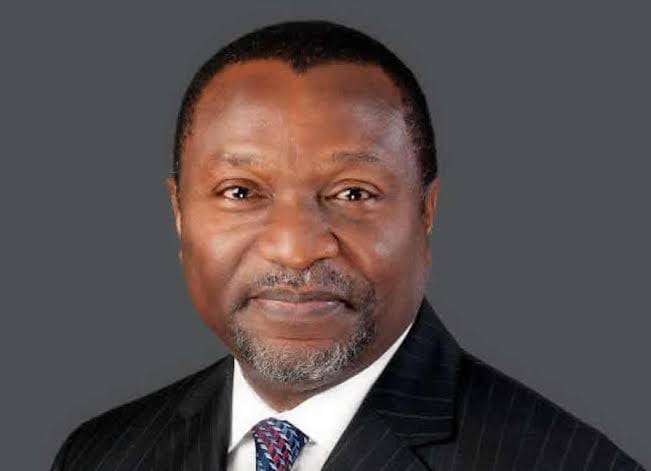
Senator Udoma Udo Udoma, CON, belongs to the group of men who inherit distinguished names, build upon the names and create formidable legacies of their own.
A lawyer, corporate statesman, politician, public policy expert and administrator, Senator Udoma has spent more than four decades at the intersection of law, business, governance and national development.
Born on February 26, 1954, in Aba, Senator Udoma, from Ikot Abasi Local Government Area, is one of the seven children of the foremost and distinguished jurist, Sir Egbert Udo Udoma, and his wife, Lady Grace Udo Udoma.
His father was one of Nigeria’s most accomplished legal minds -a Justice of the Supreme Court of Nigeria, former Chief Justice of Uganda and chairman of Nigeria’s 1977–78 Constituent Assembly. He was the first Nigerian to attain a doctorate in law from Oxford University and was knighted by Queen Elizabeth II in 1964.
Growing up in such an environment exposed young Udoma to law, public service, scholarship and national affairs from an early age.
But rather than simply inheriting his father’s reputation, he would go on to establish a formidable professional identity of his own.
His early education took him across Nigeria and East Africa.He attended Government School, Aba, from 1959 to 1961, followed by Corona School, Ikoyi, Lagos, from 1962 to 1964. When his father became Chief Justice of Uganda, young Udoma joined him there and continued his primary education at Nakasero Primary School, Kampala, from 1964 to 1965.He returned to Nigeria and attended King’s College, Lagos, from 1966 to 1972.
From King’s College, he proceeded to the prestigious University of Oxford in England, as one of very few Nigerians who have been privileged to school there, where he studied at St Catherine’s College. He obtained a Bachelor of Arts degree in Law in 1976 and a Bachelor of Civil Law degree in Jurisprudence in 1977.
He returned to Nigeria, attended the Nigerian Law School in Lagos and was called to the Nigerian Bar in 1978.
During his National Youth Service in Kano State, he was involved in setting up and organizing a legal aid scheme, an early indication of the public-service orientation that would become a recurring feature of his career.
He subsequently lectured briefly at the University of Lagos before moving into the corporate and commercial world.
In 1980, he became an Investment Analyst at Chase Merchant Bank. Thereafter, he worked as an Associate at Chris Ogunbanjo & Company and subsequently became a partner at David Garrick & Company.
In 1983, he took the decisive step of establishing his own law firm, Udo Udoma & Company.What began as a personal professional venture would eventually develop into one of Nigeria’s prominent corporate and commercial law practices.
The firm later became Udo Udoma & Belo-Osagie following his partnership with Dr. Myma Belo-Osagie. Over the years, the firm developed a strong reputation in corporate and commercial law, with particular expertise in company law, banking and finance, securities, capital markets, investment, petroleum, energy and natural resources.
But Udoma’s professional interests were never confined to private legal practice.
His expertise increasingly placed him at the centre of some of Nigeria’s most important economic and institutional conversations.
He served as the pioneer Chairman of the Corporate Affairs Commission in the early 1990s and was Special Assistant to the Minister of Petroleum and Mineral Resources (Atuekong Don Etiebet) from 1993 to 1994.
He participated in several major national policy initiatives, including work connected with the privatisation and commercialisation programme, the Nigeria Liquefied Natural Gas project, the review of national policy on solid minerals development and Vision 2010.
He was also involved in major questions relating to petroleum, natural resources and revenue allocation.
Then came politics.
In 1999, as Nigeria entered the Fourth Republic, Udoma was elected Senator representing Akwa Ibom South Senatorial District on the platform of the Peoples Democratic Party.
Fresh off his 1999 election victory, Senator Udoma was nominated and screened by the Senate for a cabinet position. During the swearing-in ceremony on June 30, 1999, at the International Conference Centre in Abuja, Senator Udoma was conspicuously absent when called upon. Reports revealed he boycotted the event after learning he was assigned a junior role as a Minister of State, opting instead to retain his legislative seat in the Upper Chamber.
His arrival in the Senate brought to the legislature the experience of a corporate lawyer accustomed to dealing with complex questions of law, finance, investment and public policy.
During his first term, he served on several important committees and subsequently became Chairman of the Senate Appropriations Committee and Vice-Chairman of the Senate Foreign Affairs Committee.
During his second term, from 2003, he became Chairman of the Senate Committee on National Planning, Revenue Mobilisation and Poverty Alleviation and later emerged as Chief Whip of the Senate.
His legislative career was marked by involvement in issues of considerable national consequence.
One of the most significant was the campaign to abolish the onshore/offshore dichotomy in the calculation of petroleum revenue for derivation purposes.
Udoma chaired the Senate committee responsible for the legislation and played a leading role in its eventual passage and enactment.
He also played a prominent role in Nigeria’s campaign for external debt relief.
In 2005, he headed the National Assembly’s Debt Relief Campaign team, which engaged Nigeria’s creditor nations and contributed to the successful negotiations that resulted in substantial debt relief for the country from the Paris Club.
Senator Udoma was also one of the prominent voices in opposition to the attempt to amend the Constitution to allow an incumbent President and state governors to seek a third term.
After two terms in the Senate, he chose not to seek a third term in 2007. Instead, he returned to professional practice while expanding his involvement in corporate governance and national economic affairs.
His post-Senate career was remarkable in its own right.He served as Vice Chairman of Linkage Assurance Plc and as a director of Unilever Nigeria Plc. He became Chairman of UAC of Nigeria Plc and subsequently Chairman of Union Bank Plc.
He also served in other major public and private-sector capacities, including at the Securities and Exchange Commission, the Nigeria Economic Summit Group and various presidential committees on economic policy and regulatory reform.
For a lawyer who had already served as a senator, corporate chairman and policy adviser, another national assignment came in 2015.President Muhammadu Buhari appointed him Minister of Budget and National Planning.
Senator Udoma stepped away from his private-sector board positions and professional commitments to serve in the Federal Executive Council.
As Minister, he became one of the central figures in the Federal Government’s economic management team during a period of severe economic difficulty.
One of his most important responsibilities was the development and implementation of the Economic Recovery and Growth Plan (ERGP), the Federal Government’s medium-term economic strategy designed to restore economic growth, diversify the economy, improve infrastructure and strengthen the environment for investment.
The plan was developed during a period in which Nigeria was emerging from recession, and his ministry played a central role in coordinating its implementation.
His tenure as minister ended in May 2019 with the conclusion of President Buhari’s first term.
After leaving the Federal Executive Council, he continued to contribute to national and institutional development.
He has maintained a strong interest in education, governance and institution-building, serving in senior university governance positions, including as Pro-Chancellor and Chairman of the Governing Council of Bayero University, Kano, and subsequently in the governance of Akwa Ibom State University as Pro-Chancellor and Chairman of Council.
His contribution to national life has been recognised with several honours.In 2005, he was named Best Nigerian Senator of 2004 at the inaugural ThisDay Awards.The University of Uyo conferred on him an honorary Doctor of Laws degree in 2011.That same year, the Federal Government honoured him with the national award of Commander of the Order of the Niger (CON).In 2019, the Government of Japan conferred upon him the Order of the Rising Sun, Gold and Silver Star, one of Japan’s distinguished national honours. He was the first Nigerian to receive that particular honour.
For Akwa Ibom, Senator Udoma Udo Udoma represents a particularly important strand of the state’s contribution to Nigeria.He belongs to a generation of Akwa Ibom professionals who demonstrated that excellence could be carried from the classroom into the legal profession, from the legal profession into business, and from business into the highest levels of national public service.
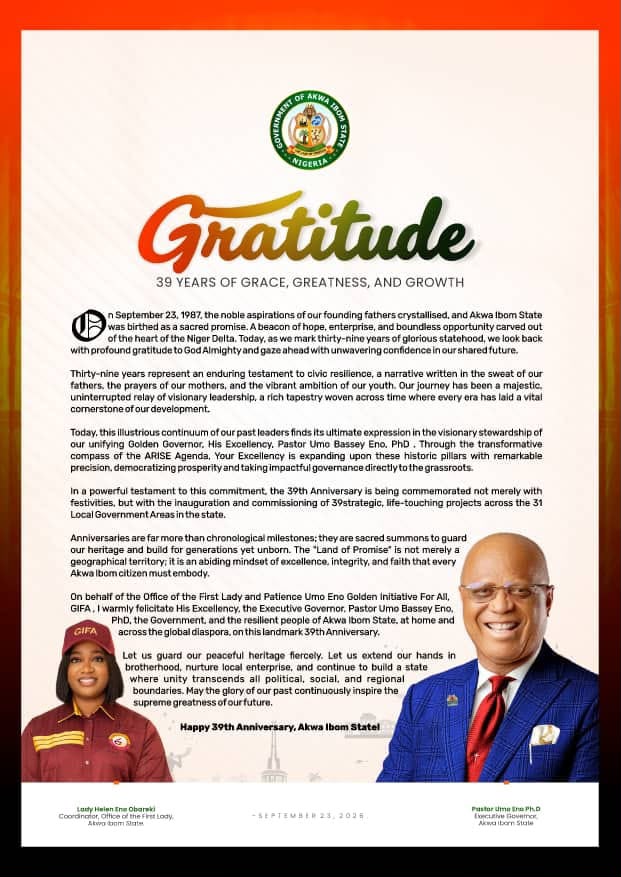
As Akwa Ibom marks 39 years of statehood, Senator Udoma Udo Udoma, CON, stands among the state’s distinguished professional and public-service pioneers, one of the men whose careers have demonstrated that the intellectual and professional capital of Akwa Ibom can compete at the highest levels of national and international life, and one who fought for the economic liberation of the people.
He is, indeed, an Akwa Ibom PRIDE.
#AkwaIbomAt39
#IbomLeadingLights
#CelebratingOurHeroesOurPrides
#39Heroes39Prides
#PrideUdomaUdoUdoma
#The39thAnniversaryCollectives
#AkwaIbomStateMinistryOfInformation
#AriseAgenda