By IKPAT UduakAbasi
When Akwa Ibom State was created on September 23, 1987, by General Ibrahim Babangida popularly called IBB, it also represented the culmination of a long quest and dream for political identity and administrative autonomy by the people of the area carved out of old Cross River State. The creation made a political reality and placed before a new generation of leaders the responsibility of building institutions capable of translating that historic victory into development.
Thirty-nine years on, the anniversary now offers our people, an opportunity to examine not only how far the state has travelled, but the foundations upon which its future is being built.
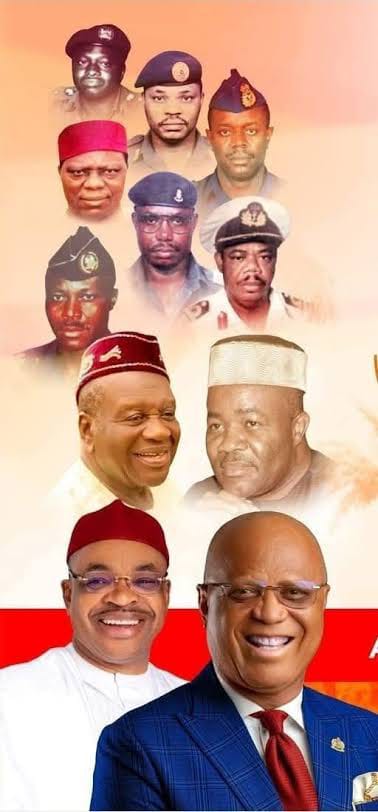
The early years were necessarily formative. Colonel Tunde Ogbeha, Colonel Godwin Abbe and Wing Commander Idongesit Nkanga successively administered the young state before Obong Akpan Isemin emerged as its first civilian governor in 1992.
Subsequent administrations, including those of Yakubu Bako, Joseph Adeusi and John Ebiye, navigated the state through a period in which political instability and military intervention remained dominant features of Nigeria’s national life.Their era established the early administrative structures from which the more enduring democratic institutions would build.
With the return of sustained democratic rule in 1999, Arc. Victor Attah began a new phase in Akwa Ibom’s political history. His administration was associated with a stronger assertion of the state’s interests within the federation, particularly around resource control and the controversial onshore-offshore revenue question.
A period which deepen our people’s consciousness of economic possibilities, setting the stage for a succession of other administrations that would increasingly define robust development through vast public infrastructure, investment and unstoppable economic expansion.
Afterwards came the Chief Godswill Akpabio’s administration, from 2007 to 2015, which became strongly identified with large-scale infrastructure and an extensive transformation of the state’s physical landscape. With modern Roads, public buildings and urban projects, particularly around Uyo, became the enduring legacies of that very era.
Whatever debates accompanied the scale or actual cost of seen development, the administration undeniably became an important chapter in the state’s evolution establishing also transformation as a central reference point in measuring successive governments efforts.
Then came Mr. Udom Emmanuel, not a career politician but from the private banking sector, who followed in 2015, he shifted considerable attention toward industrialisation, investment and economic diversification, while continuing several infrastructure projects.
And by the time the incumbent Governor Umo Eno assumed office in May 2023, Akwa Ibom was no longer the young state of 1987. It had accumulated nearly four decades of intensed political experience, substantial infrastructure and a growing expectation that development should move beyond government projects into broader prosperity of it populace.
He inherited both notable achievements and unfinished ones from predecessors, and introduced the ARISE Agenda as its governing framework to consolidate, the blueprint is built on holistic and robust agricultural revolution rural development, infrastructure, security, and education, with the wider objective of creating a diversified and inclusive economy.
Three years into the present administration, infrastructure remains prominent in the state’s development narrative, but with a stated attempt to extend the benefits beyond the urban centres. Governor Eno revealed in April 2026 that his administration had embarked on more than 1,300 kilometres of roads, while the State Executive Council subsequently approved additional road projects covering more than 167 kilometres across the state.
The government has also highlighted projects in primary healthcare, quality education and rural development as part of its effort to spread public investment across the 31 local government areas.
The administration’s social and economic interventions have provided another dimension to its governance agenda.
Among those highlighted by the governor are the Arise Compassionate Homes programme, agricultural grants and equipment support, rural water initiatives and youth-oriented centres. Agriculture has received particular emphasis, including the Ibom Model Farm, an allocated ₦2 billion agricultural grant and plans for a palm-tree crop revolution backed by the proposed distribution of hundreds of thousands of seedlings.
These initiatives point to an effort to connect government intervention with household welfare, rural productivity and longer-term economic opportunity. Yet Akwa Ibom’s story cannot be measured solely by number of roads constructed, buildings commissioned or programmes launched. More difficult test is whether public investment produces sustainable economic activity, quality employment and improved household welfare.
A state whose economy has historically benefited substantially from oil revenue must increasingly confront the realities of diversification of it local economy and by strengthening mechanized agriculture, small businesses, tourism, technology, manufacturing maritime economy.
The proposed Ibom Deep Seaport and continued expansion of aviation and tourism ambitions and therefore carry significance beyond individual projects, they speak to the question of what Akwa Ibom’s economy should look like after the era of oil-dependent public spending.
That question becomes even more important because the state’s greatest asset may ultimately be its people. A youthful population requires an economy capable of absorbing it talent, rewarding enterprise and creating pathways from education to actual productive work.
Successive administrations have invested in physical infrastructure, but the next level of development will require equal attention to skills, innovation, healthcare, education, digital skills, manpower expansion and private-sector growth.
The measure of the state’s progress must increasingly be found in the opportunities available to citizens rather than only in the structures visible along its highways.
There is notable continuity. Akwa Ibom’s development remain cumulative, projects conceived under one administration have sometimes been completed by another, and while policy priorities have evolved according to changing economic realities and actual political circumstances.
The current governor has acknowledged the contributions of past leaders and the importance of building on what already exists. That approach is critical because sustainable development cannot depend entirely on the personality or political philosophy of who occupies the ‘Hilltop Mansion’ at a particular time, it requires the institutions and public policies capable of surviving transitions of government.
At 39, the state can therefore look back on a remarkable transformation from a newly created administrative entity into one of Nigeria’s better-known subnational economies and political spaces.
But the anniversary also exposes the distance between development achievements and the larger aspirations of the people. The questions of jobs, cost of living, rural development, education, healthcare, investment, accountability and economic independence remain as consequential as the question of how many kilometres of roads have been built.
Those issues will determine whether the physical transformation of the past decades becomes lasting improvement in the quality of life. The journey so far is ultimately a story of successive hands building on an evolving foundation.
From Babangida’s creation of the state and the early administrators, through Isemin, Attah, Akpabio and Emmanuel, to the present administration of Governor Umo Eno, every era has added something to the Akwa Ibom story.
As the state clocks 39, the responsibility now is not merely to celebrate what has been achieved, but to consolidate it, interrogate what remains unfinished and prepare for a future in which notable development is measured increasingly by human prosperity, institutional strength and the opportunities available to every generation of Akwa Ibomites.